


1
Productivity without prosperity
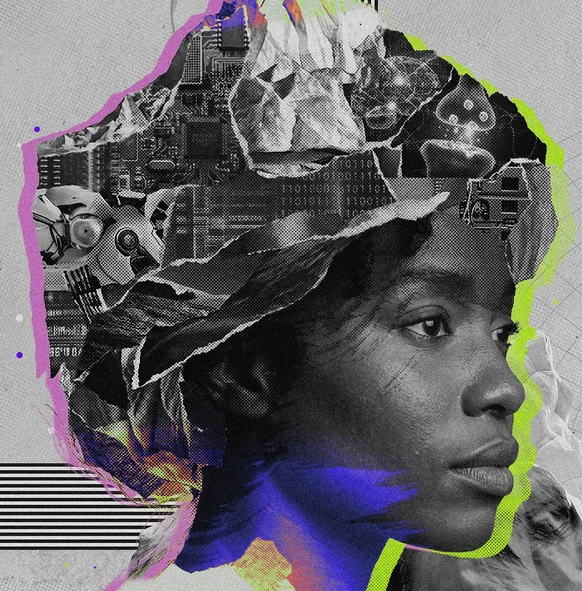
Work gets reorganized faster than people can retrain or move, and the gains never reach most of them.
Animated gravity field
For every dollar spent making AI more capable, a fraction goes toward the institutions, skills, and norms that decide whether its benefits are shared or squandered. That gap is a choice. We are a coalition working to close it.
The idea / Introduction
Most of the effort and capital in AI goes to two tasks: making systems more capable, and aligning those systems with human values.
Both matter. But even a perfectly aligned system will underdeliver, or do real harm, if it is released into economies, governments, and information systems unprepared to receive it.
We call that neglected work reverse alignment: the deliberate redesign of institutions, norms, skills, and governance so that societies can absorb AI safely and share its gains widely.

Industrialization, electrification, and the internet each demanded decades of institutional invention before their benefits arrived. The companies of the assembly line looked like assembly lines. The institutions that governed the internet looked like the internet.
History suggests these adaptations are not optional add-ons to technological change. They are the conditions for its success.

Left unaddressed,
the mismatch produces three predictable failures.
1
Work gets reorganized faster than people can retrain or move, and the gains never reach most of them.
2
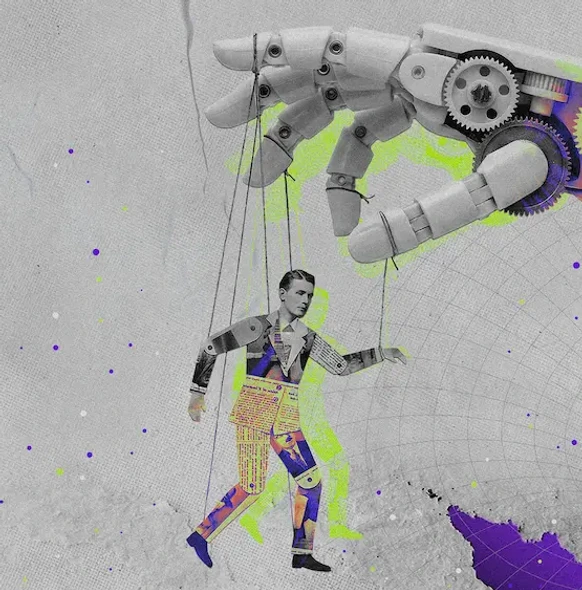
As the cost of generating text, images, and code collapses, the scarce input becomes the human capacity to check, attribute, and stand behind what gets produced.
3
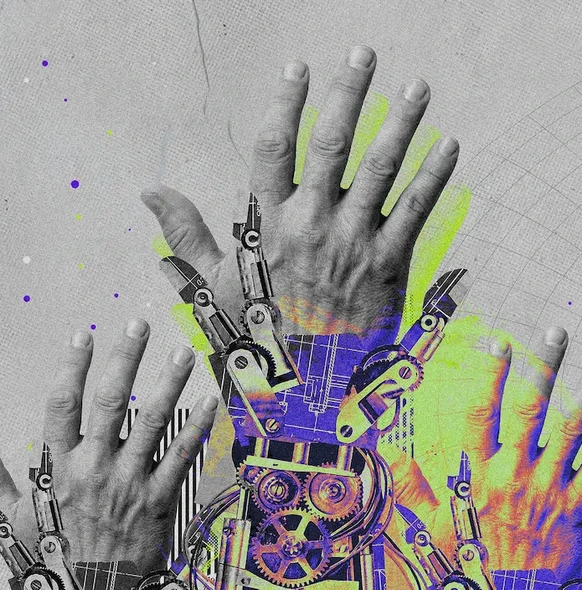
The same tools that make institutions more capable can concentrate power, unless rights of appeal and contest advance alongside them.

None of these is inevitable.
Each is a consequence of neglect, and neglect can be reversed.
Human flourishing over the next decade depends on a set of sociotechnical grand challenges.
Summary of recommendations
Large, coordinated investments in the human and institutional side of the AI transformation. They span identity, privacy, markets, governance, work, and knowledge. They share an architecture, and they share a method. No single sector can deliver any one of them alone.
*Hover to read more *Click to read more
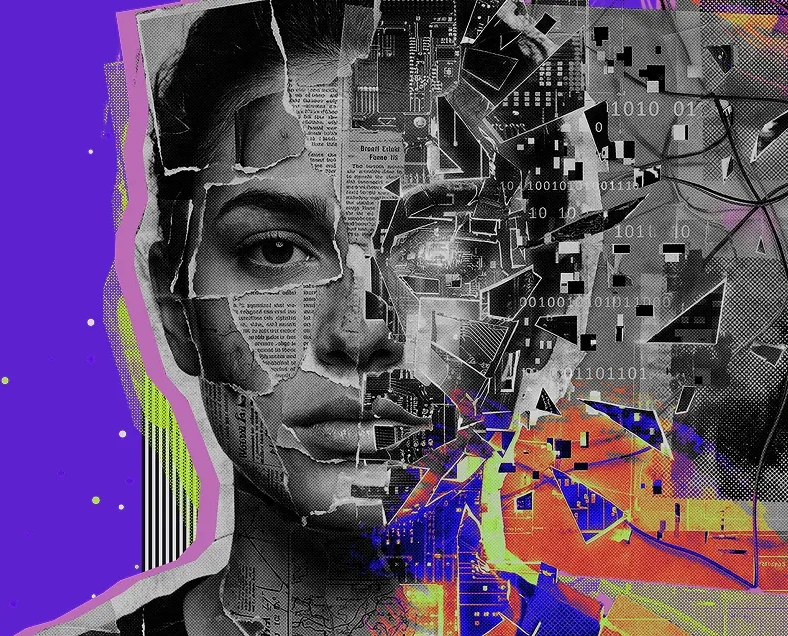
As fake documents, biometrics, and synthetic personas approach zero cost, we need ways to prove a real, unique human is present without revealing who they are.

AI gives everyone a personal detective; the answer is not blanket secrecy or full exposure but tools that let people reveal exactly what a situation calls for and nothing more.
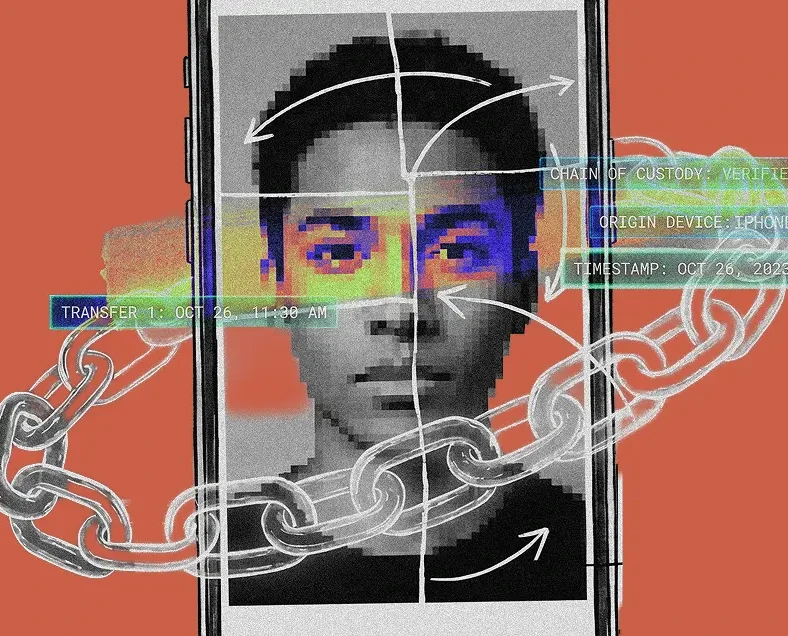
When a convincing fake costs nothing to make, knowing where content came from becomes essential to a shared reality.
The human record that trains these models was taken at almost no cost; the people who created it deserve a real market and durable compensation, which the companies’ own measurements already make possible.

AI agents are most useful when they pool what each one knows, and that requires trust built the way humans build it, across providers rather than inside walled gardens.
Media that rewards outrage and obscures who agrees with whom can be redesigned to surface common ground while representing real disagreement fairly.

The authority that thriving communities generate has to translate into real power over resources, which means modernizing participation, representation, and the unglamorous work of implementation.
AI lowers the cost of surveillance and enforcement in ways that favor the executive; restoring balance means building equivalent capacity for oversight, contest, and appeal.

The bottleneck to AI’s productivity gains is not individual speed but whether organizations can be redesigned to absorb a surge of creativity and agency.

Models now generate hypotheses and drafts faster than peer review can sort them, and the same tools, aimed well, can reward genuinely original, silo-breaking work.

AI breaks the old bundle of teaching, learning, and credentialing, forcing schools to name the capacities that matter and certify what people actually know.
A workforce system built for mass layoffs at a single employer cannot handle the continuous, fine-grained reshaping of work that AI produces; it needs portable, interpretable credentials and real-time retraining.
The distinctive claim
There is a pattern in how societies absorb a new general-purpose technology. The institution that succeeds tends to mirror the architecture of the era’s dominant way of thinking.
The industrial age organized cognition around standardized accounting and the assembly line, and it produced hierarchical, divisional institutions to match: the corporation, the central bank, the chartered multilaterals of Bretton Woods. The internet age organized cognition around layered protocols and distributed routing, and it produced layered, cooperative bodies to match: the standards organizations, the messaging cooperatives, the open process of the Request for Comments.
Neural networks impose a third grammar. They represent things by their position in a rich space rather than by a single label. They combine differing inputs by weighting how each bears on the others, finding common structure without averaging away difference. They assign credit by tracing each contribution to its effect.
When the institution and the technology share a grammar, the gains arrive. When they don’t, the gains stall. Electrified factories delivered little for nearly two decades while they kept the layout of the steam-powered plant; the productivity came only once factories were redesigned around the distributed electric motor.
The wager of this coalition is that the institutions able to absorb AI will be the ones that instantiate these same moves at the scale of society. The work is to build them on purpose.
The papers
In Noema —

The fuller, public statement of the problem and the agenda: the three failure modes, the historical precedents from mass democracy to Taiwan’s digital governance, and the full set of sociotechnical grand challenges. The place to start.
Read in Noema (opens in a new tab)Working paper —
The crisp engineering principle behind the agenda: why institutions come to resemble the cognitive technology of their age, and what it means to build in the shape of a neural network. The distinctive thesis, with the historical record and the technical mapping.
Coming soonWhat AI Can’t Build, a storyteller’s guide that turns these challenges into dramatic material for writers and creators, with a high-concept pitch and a writers’-room prompt for each one.
The summary presentation behind the recommendations.
The Institute for Progress is running a rolling call for essays describing concrete, ambitious AI projects — sociotechnical proposals included. Selected authors get editorial support, a $10,000 honorarium, and a path to philanthropic funding.
Every institution we rely on was once unimaginable, until stories made enough people care to build it. The human challenges of AI are not policy abstractions. They are the raw material for the most important stories of the next decade, and most of them have not been told yet.
We made a guide for
the people who can tell them.
What AI Can’t Build takes each challenge and hands writers a high-concept pitch and a set of prompts to drop into the writers’ room: the woman fighting for the right to be different people in different parts of her life, the documentary maker whose airtight film meets an equally airtight rebuttal, the data contributor who is rich, essential, and completely anonymous.
 Watch the video (opens in a new tab)
 See how we brought these ideas into a room with 100 TV writers.
Watch the video (opens in a new tab)See The Challenges
We are also working with independent creators to bring these challenges to life, one at a time, in plain language. Each short film takes a single problem, from proving you’re human online to paying people fairly for the data that trains AI, and shows why it matters and what a solution looks like.
First films arriving soon.
We are funding storytellers who weave these ideas into their work.
If you write, film, build games, or make things people watch, and you want to incorporate or reinterpret any challenge here, we want to support it.
You don’t have to explain the policy. You just have to make people feel what’s at stake.
This work was shaped by people who rarely sit at the same table.
AI researchers and social scientists, technologists and public servants, funders and civic builders, drawn from across regions and political perspectives. That range is not incidental. The method we advocate, finding common ground across real differences without suppressing them, is the method that produced the work itself.
Sector
Use filters to narrow; results update as you type.
Co-founder, RadicalxChange Foundation
He co-founded and leads the Plural Technology Collaboratory at Microsoft Research’s Catalyst Lab, the RadicalxChange Foundation, the Plurality Institute and the Faith, Family and Technology Network. He is co-author with Eric Posner of the 2018 The Economist Book of the year Radical Markets; with Puja Ohlhaver and Vitalik Buterin of one of the most downloaded papers ever on the Social Science Research Network, "Decentralized Society”; and with Audrey Tang and a global community of the first democratically governed, fully open-source book ⿻ 數位 Plurality (2024). He has published academic articles in leading academic journals across fields including biology, business, computer science, economics, law, philosophy, and theology. He has been recognized by Bloomberg Businessweek, Coindesk, and WIRED as one of the leading thinkers shaping business and technology and is one of the first technologists to win a major prize for international religious freedom. He graduated as Valedictorian of Princeton’s 2007 class and received his PhD in economics from the same in 2008.
Cyber Ambassador, 🇹🇼Taiwan
Civic hacker, co-author of «Plurality» (with Glen Weyl) and the forthcoming «Civic AI» (with Caroline Green). She is a Carnegie Distinguished Fellow at the Institute of Global Politics, Columbia SIPA and an inaugural Senior Accelerator Fellow at the Oxford Institute for Ethics in AI. She served as Taiwan's first Minister of Digital Affairs (2022–2024), preceded by six years as Minister without Portfolio for Digital Affairs (2016–2022), and is the world's first nonbinary cabinet minister. Tang was instrumental in the g0v (gov-zero) network and played a pivotal role in the 2014 Sunflower Movement, facilitating digital consensus-building during the occupation of Taiwan's legislature. As Digital Minister, she implemented radical transparency through participatory democracy platforms like vTaiwan and Join, with innovations such as the "Mask Map" during COVID-19 and defenses against cyber interference in the 2024 elections. In 2025, Tang received the Right Livelihood Award — often called the Alternative Nobel — "for advancing the social use of digital technology to empower citizens, renew democracy and heal divides."

Head of Partnerships, The Dais
Head of Partnerships at The Dais, Canada’s leading think tank. Current foci include “Kids and Tech”, “Renewing Democracy” and “AI and the Innovation Economy.” Jake is a Senior Public AI, Fellow, an advisor to Avalanche VC and a speaker with ProjectSpeaker. Jake previously built public-private partnerships in workforce development and higher education for LinkedIn. Jake advises impact investors, public sector leaders and start-ups, including on edTech, responsible tech, ethical data and Public AI. He co-founded Lighthouse Labs and has acted as a director on many boards including the Canadian Club of Toronto. A former intellectual property and international criminal lawyer, Jake was also chair of the Technology Committee of the Global Education Platform, taught Global Health at McMaster University and clerked at the Supreme Court of Israel.
President, Patrick J. McGovern Foundation
Globally recognized authority on artificial intelligence and society, serving as President of the Patrick J. McGovern Foundation, a $1.5 billion philanthropic organization advancing AI for the public good. He has served on the United Nations Secretary-General’s High-Level Advisory Body on Artificial Intelligence, is the U.S. Government’s nominated expert to the Global Partnership on AI, and advises Stanford’s Institute for Human-Centered AI, OECD.AI, and MIT Solve. Named a World Economic Forum Young Global Leader in 2022, his essays and commentary have appeared in TIME, U.S. News & World Report, Nature, Indian Express, The Wall Street Journal, and The Boston Globe. His LinkedIn Learning course, Ethics in the Age of Generative AI, has been translated into six languages and reached over 750,000 learners worldwide. He holds a J.D. from NYU School of Law, an M.P.A from the Harvard Kennedy School, and dual Bachelor’s degrees in Biomedical Engineering and Computer Science from the University of Illinois .

Associate Professor, Stanford University
Tenured Associate Professor in the Department of Management Science and Engineering at Stanford University and a Senior Fellow at the Stanford Institute for Human-Centered Artificial Intelligence (HAI). Her research examines how AI and algorithms are reshaping work and organizations, focusing on AI-powered organizations, algorithmic management, and organizational design. Professor Valentine’s work has received numerous honors, including the NSF CAREER Award and multiple best paper awards. She has published in leading journals such as Organization Science, Management Science, and Administrative Science Quarterly, and her research has been featured in The New York Times, The Wall Street Journal, Harvard Business Review, and Wired. She earned her bachelor’s degree from Stanford University, her master’s degree from New York University, and her Ph.D. from Harvard University.

Google Fellow; UC Berkeley Professor Emeritus
UC Berkeley Pardee professor emeritus, a Google Fellow, and Laude Institute Board Chair. His most influential Berkeley projects were RISC and RAID and his best-known book is Computer Architecture: A Quantitative Approach. He and his co-author John Hennessy shared the 2017 Turing Award and the 2022 NAE Draper Prize (“Nobel Prizes” of their fields).
Associate Professor, Harvard Business School
Ralph J. Maffei Associate Professor of Business Administration in the Strategy Unit at Harvard Business School. She studies how leaders and organizations think, decide, and act in highly uncertain contexts. She teaches an MBA elective on Making Difficult Decisions, a PhD seminar in Strategy Research Development, and contributes to various executive education programs. She was named a Poets & Quants 40 Best Under 40 Business School Professors and a Radar Thinker by Thinkers50, the global ranking of management experts. Before joining HBS, Professor Zuzul was an Assistant Professor at the London Business School, and at the University of Washington. Professor Zuzul holds a doctorate in Strategy from Harvard Business School, MSc with Distinction from the London School of Economics, and AB with Honors from Harvard College.

Executive Director, RadicalxChange Foundation
Executive Director of RadicalxChange Foundation, an international nonprofit advancing participatory governance for the age of AI. RadicalxChange champions Plurality — a commitment to keeping human agency and democratic participation central to technological development — through research, civic technology prototypes, and partnerships that build civic capacity in communities around the world. Previously, Jess served as Deputy Lord Mayor of Sydney, co-founded and directed Australia's largest creative industries festival and held roles as a World Bank consultant, ministerial policy adviser, editor, and broadcaster. She is Chair of Parents for Climate, a member of Women for Election's Political Advisory Board, and a Senior Associate at the Sydney Policy Lab. Her book Glimpses of Utopia: Real Ideas for a Fairer World explores community-led solutions and institutional innovation to address the climate and inequality crises.

Head of Strategic Futures, OpenAI
Incoming Head of Strategic Futures at OpenAI and author of the AI-focused newsletter Hyperdimensional. His work focuses on technological change, institutional evolution, and the future of governance.Prior to this, he served as Senior Policy Advisor for Artificial Intelligence and Emerging Technology at the White House Office of Science and Technology Policy, where he was the primary staff drafter of America’s AI Action Plan.

Founder & Executive Director, Pathos Labs
Founder and Executive Director of Pathos Labs, a nonprofit working at the intersection of culture, media, technology, and social change. Through Pathos Labs’ PopShift program, he has worked with leading TV writers, showrunners, YouTubers, academics, philanthropists, and movement leaders to help reshape the narratives that influence how millions of people understand the world. Romain has led more than 20 private convenings with over 450 storytellers and creators, built partnerships with major entertainment companies including Disney, Warner Bros. Discovery, Paramount, Participant, and CAA, and created narrative programs that help translate urgent social ideas into culture.
Head of Research, Office of Eric Schmidt
Head of Research at the Office of Eric Schmidt, where he leads special projects at the intersection of technology, democracy, and geopolitics. Specifically, Andrew oversees new work that uses AI to build public trust, strengthen collective decision-making, and ensure democratic oversight of advanced AI itself. He previously served as lead researcher for Fareed Zakaria's Age of Revolutions and held a research role at CNN. Andrew’s writing has appeared in outlets including the New York Times, MIT Technology Review, Noema, and Foreign Policy, and he advises governments and other institutions piloting governance innovations.

Fellow, Foundation for American Innovation
Nonresident fellow at the Foundation for American Innovation, where he researches legal structures shaping technological innovation and regulatory reform. He is also a JD candidate at Scalia Law School at George Mason University. He holds a business honors degree from the University of Texas at Austin and focuses on modernizing environmental permitting to accelerate infrastructure and national competitiveness. He previously worked in legislative policy, legal consulting, and managed a fast-growing energy logistics firm, Mobile Force Refueling.
Lab Director, Microsoft Research
Vice President and Lab Director, Catalyst Lab. He leads research teams with world-class specialists solving highly uncertain, complex problems. His group’s work at Microsoft Research includes software engineering and system development for emerging industry and societal challenges, including generative AI memory and retrieval, security and AI, plurality, human rights, and cryptography and privacy. Prior to Microsoft, Chris was a Program Manager at the Defense Advanced Research Projects Agency (DARPA), where he created and managed the XDATA and Memex programs and directed major investments in open-source software. He also served as DARPA’s country lead in Afghanistan, leading multinational deployments of advanced technology. In recognition of this work, Chris received the 2016 Presidential Award for Extraordinary Efforts to Combat Trafficking in Persons, the Secretary of Defense Medal for Outstanding Public Service, and several other national honors.

President, Project Liberty
President of Project Liberty, where he works to give people greater agency over their data and broader access to the economic benefits of innovation. He previously led policy for Andreessen Horowitz and Haun Ventures, and served as Senior Advisor to two U.S. Secretaries of State. He joined the State Department in 2009 as Hillary Clinton's speechwriter and spent four years on the Senate Foreign Relations Committee alongside Joe Biden, Anthony Blinken, Barack Obama, and John Kerry. Tomicah also served as Executive Director of the Digital Impact and Governance Initiative at New America, where he led programs on technology, asset allocation, and democratic governance, building solutions to strengthen democratic institutions and private sector accountability worldwide. A co-holder of four patents, he has served on advisory councils at the World Economic Forum and the UN World Food Program. He holds a B.A. magna cum laude from Yale and a Ph.D. with distinction from Johns Hopkins SAIS, and is a life member of the Council on Foreign Relations.

Founder & Principal, Minerva Fund
Founder and Principal of the Minerva Fund, which supports democratic governance and public-sector innovation. He is also the co-founder and Vice Chair of Recoding America, a $120 million initiative to improve government effectiveness and competitiveness. Galen serves on several boards and advisory councils, including the University of Chicago’s Harris School of Public Policy, the American Governance Institute, and the Stimson Center. He is also a strategic advisor to the Digital Parliaments Project and co-founder of the AI-Enabled Policymaking Project (AIPP). Previously, Galen was a federal civil servant supporting trade policy and negotiations. He has authored research on embedding human values in AI systems to strengthen democratic decision-making. He holds an MPP from the University of Chicago, an International Studies degree from Virginia Commonwealth University, and is a life member of the Council on Foreign Relations.

Former White House AI Advisor
Dmitri Alperovitch Assistant Professor at Johns Hopkins School of Advanced International Studies. Prior to coming to Hopkins, he worked in the White House from 2021-2025, including as White House Special Advisor for Artificial Intelligence, where he was responsible for coordinating the Biden Administration actions on AI. He is the author of four books on AI, cybersecurity, and national security, including The Bitter Struggle.

Professor, University of Chicago
Max Palevsky Professor of Sociology and Data Science, Director of Knowledge Lab and Founding Faculty Co-Director of the Chicago Center for Computational Social Science at the University of Chicago, the Santa Fe Institute, and Google. Evans' research uses large-scale data, machine learning, and generative models to understand how collectives of humans and machines think, what they know, and the limits and possibilities of collective intelligence. His work explores the emergence of ideas, shared patterns of reasoning, and processes of attention, communication, agreement, and certainty across science, the web, and other complex systems. Supported by major U.S. federal agencies (NSF, NIH, DOD), foundations, and philanthropies, his research has been published in Nature, Science, PNAS, and top social science and computer science outlets, and has been covered by global news outlets from the Economist, Atlantic , and New York Times to Le Monde, El Pais, and Die Zeit.

Dean, Harvard College
Danoff Dean of Harvard College, the Isabelle and Scott Black Professor of Public Policy at Harvard Kennedy School, and the William Henry Bloomberg Professor in the Harvard Economics Department. His research focuses on higher education, skills, technology, AI, and the future of work. In 2018 he was awarded the David Kershaw Prize for distinguished contributions to public policy and management for a scholar under the age of 40. In 2022 he was awarded the Sherwin Rosen Prize for distinguished contributions to labor economics. He co-leads the Project on Workforce at Harvard and co-founded the Skills Lab, which develops performance-based measures of “soft” skills like teamwork and decision-making. His writing has appeared in the New York Times, the Atlantic, and on his substack Forked Lightning. He also hosts a podcast called The Context Window.

Project Professor, Keio University
Researcher in complex systems science and natural philosophy. Since June 2026, he has been a Project Professor at Keio University and Co-Director of the Plurality and Nameraka Society Research Center of Excellence (PRANCE). Since 2025, he has also led "Digital Democracy 2030," a non-profit open-source community promoting technology-driven, participatory policymaking. His research explores how science and technology can help preserve complexity while fostering interconnected societies. He is also the co-founder and Executive Chair of SmartNews, a Japan-born unicorn and one of the world’s most popular news apps, designed to counter political polarization by presenting multiple perspectives. He was named Forbes Japan Entrepreneur of the Year (2020) and received the Japan Startup Award from Prime Minister Kishida (2023).

VP & Fellow, Google
VP and Fellow at Google, where he is the CTO of Technology & Society and founder of Paradigms of Intelligence (Pi). Pi is an organization working on fundamental research in AI and related fields, especially the foundations of neural computing, active inference, sociality, evolution, and Artificial Life. In 2008, Blaise was awarded MIT’s TR35 prize. During his tenure at Google, Blaise has innovated on-device machine learning for Android and Pixel; invented Federated Learning, an approach to decentralized model training that avoids sharing private data; and founded the Artists + Machine Intelligence program. An External Professor at Santa Fe Institute and a frequent public speaker, Blaise has given multiple TED talks and keynoted NeurIPS. He has also authored numerous papers, essays, op-eds, and chapters, as well as two previous books, Who Are We Now? and Ubi Sunt. He recently published What Is Life?, which is part 1 of the larger book What Is Intelligence?, and both were released in 2025 by Antikythera and the MIT Press.
Professor, Harvard University
James Bryant Conant University Professor at Harvard University, where she directs the Allen Lab for Democracy Renovation at the Harvard Kennedy School and the Democratic Knowledge Project at the Harvard Graduate School of Education. A political philosopher trained as a classicist, she works at the intersection of democratic theory and institutional design, with current work on how societies can steer artificial intelligence toward broad-based empowerment rather than concentration. She is the author of many books on the theory and practice of democracy, including Justice by Means of Democracy, Our Declaration, and, most recently, Radical Duke (2026); she also publishes The Renovator, a Substack on rebuilding American democracy. A MacArthur Fellow and recipient of the Kluge Prize for Achievement in the Study of Humanity, she has chaired the boards of the Mellon Foundation and the Pulitzer Prizes, and founded and chairs the board of Partners In Democracy.

Co-founder, Collective Intelligence Project
Divya Siddarth is the co-founder of the Collective Intelligence Project (CIP), which works to democratize the development of artificial intelligence. CIP has worked with partners including the Taiwanese Digital Ministry, the UK AI Security Institute, OpenAI, Anthropic, and Mistral to apply new governance models to AI and to build AI-enabled platforms for collective decision-making. CIP's work has brought tens of thousands of people from over seventy countries into shaping the future of transformative AI. Divya most recently led the Economic Futures program at the OpenAI Foundation. She previously built the societal impacts function at the UK AI Security Institute and served as a political economist in Microsoft's Office of the CTO. She was named one of the TIME 100 Most Influential People in AI and is completing a PhD at the Oxford Internet Institute.
Founder & CEO, O’Reilly Media
Founder and CEO of O'Reilly Media, Inc. His original business plan was simply "interesting work for interesting people," and that's worked out pretty well. He publishes books, runs online conferences, invests in early-stage startups, urges companies to create more value than they capture, and tries to change the world by spreading and amplifying the knowledge of innovators. He’s perhaps best known for shaping big ideas like open source software, unconferences (Foo Camp), Web 2.0, and government as a platform. His 2017 book WTF? What’s the Future and Why It’s Up to Us explored the role of human agency in shaping the future in the face of the AI wave. These days, he’s focused on mechanism design for the human-AI economy, exploring these ideas through the non-profit AI Disclosures Project, which he co-founded with Ilan Strauss. He also writes frequently on Substack through O’Reilly Radar, the AI Disclosures Project’s Asimov’s Addendum, and Conversations with AI.
Founder & Managing Partner, Ex/Ante
Zoe Weinberg is the founder & managing partner of ex/ante, an early-stage venture fund focused on technology that supports human agency and user control over privacy, data, assets, and information. Prior, Zoe worked on ethics and policy at the National Security Commission on Artificial Intelligence and at Google AI. Previously she focused on fragile and conflict-affected states, working on the emergency response in Mosul, Iraq during the counter-ISIL operation in 2017, and at the World Bank (IFC) in over a dozen countries, including Somalia, South Sudan, and Liberia. Prior to the World Bank, she worked in Goldman Sachs’s alternative investment group. Her research and writing has been published in the New York Times and Foreign Affairs, among other publications, and she served as a host of the podcast Next in Foreign Policy (produced by the Deep State Radio Network) from 2021-23. Zoe earned her B.A. from Harvard University, a J.D. from Yale Law School, and an M.B.A from Stanford’s Graduate School of Business, where she was a Knight Hennessy Scholar.

Founder, Ethereum
Vitalik Buterin conceived Ethereum in 2013, authored its original whitepaper, and remains an active researcher and contributor to the protocol’s technical and philosophical direction. He co-founded Bitcoin Magazine before helping launch Ethereum, a general-purpose blockchain for smart contracts and decentralized applications, in 2015. His work spans cryptography, scaling, mechanism design, privacy, public-goods funding, and decentralized governance.

Researcher, Civic.AI
Tenzin Yangtso (Gisele Chou) is a contributing co-author of ⿻Plurality and Producer of its Mandarin edition. She collaborates with the Oxford Institute for Ethics in AI (IEAI), where she co-cultivates the locally-tended Civic AI "jdd-kami" with Audrey Tang and brings Tibetan Buddhist ethics into dialogue with care ethics in Civic AI design. She introduced the concept of "data soil" and proposed the Data Altruism direction while at the Ministry of Digital Affairs. Her Tibetan name was bestowed by His Holiness the 14th Dalai Lama.
Join the coalition
Reverse alignment is not one project. It is a portfolio of bets, in every sector, that only a broad coalition can sustain.
If you believe we should build for our social systems as ambitiously as we build for our algorithms, lend your name and help carry the work into your own field.
Join the coalition (opens in a new tab)